
Miyaragawa Mangrove | Ishigaki's Largest Hirugi Forest, SUP, Canoe Tours & Access
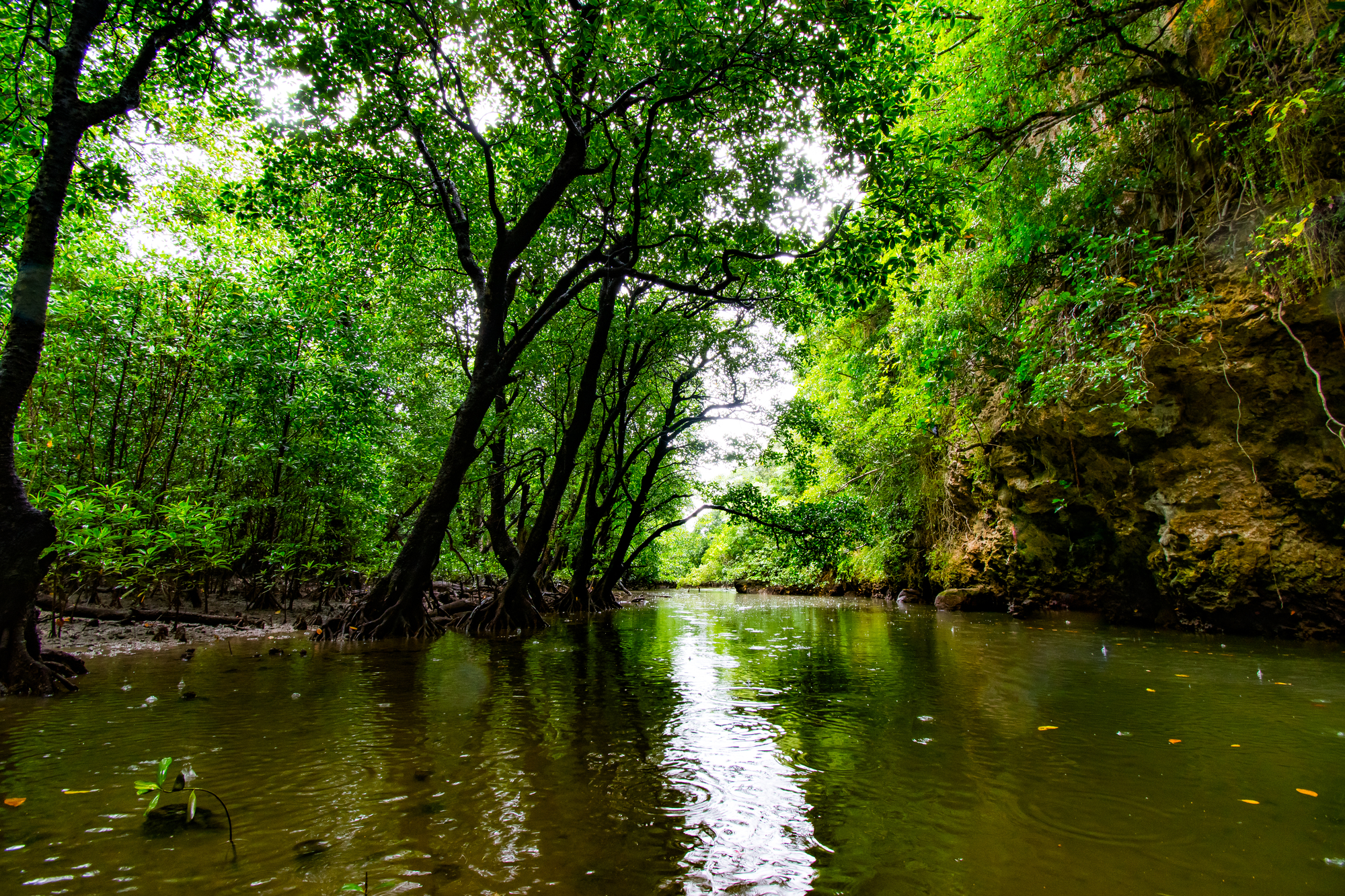
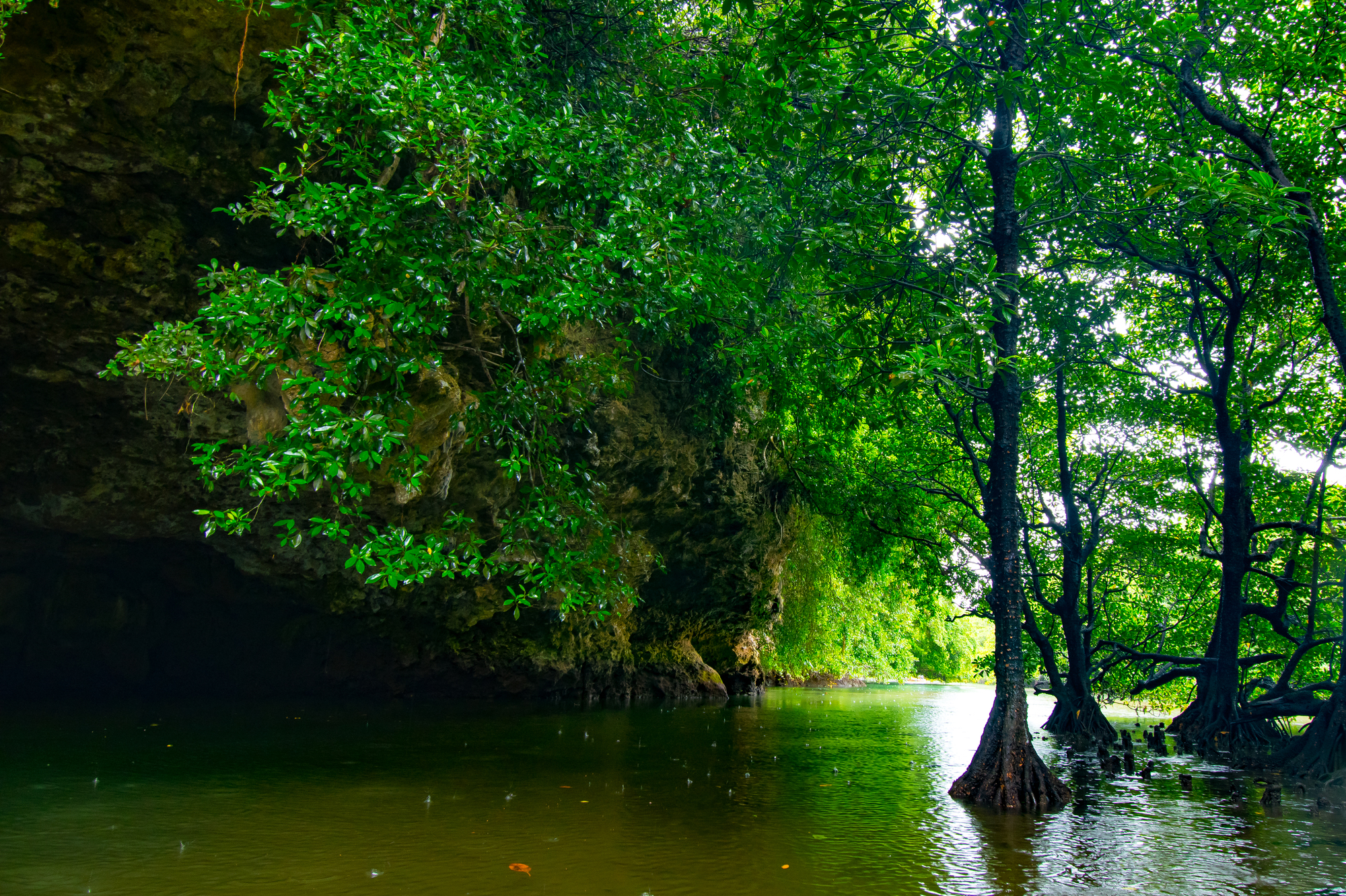
Ishigaki’s longest river, the Miyara River. “The Hirugi (mangrove) Forest of the Miyara River,” spreading 1.5 km along both banks from its mouth to upstream, is 225 ha in area—a domestically foremost mangrove grove reaching about 48 Tokyo Domes. A subtropical jungle designated a national Natural Monument in 1972, where an extraordinary space spreads out as if it weren’t Japan.
A popular spot where you can casually enjoy mangrove cruising by SUP or canoe, with outstanding access of about 10 minutes by car from New Ishigaki Airport. The big appeal is that you can savor a jungle adventure even in the short time of an arrival or departure day. In this article, we’ll deliver a complete guide to Miyara River mangrove’s appeal, how to enjoy it, tours, access, and cautions.
What Kind of Place Is the Miyara River Mangrove? Ishigaki’s Largest Hirugi Forest
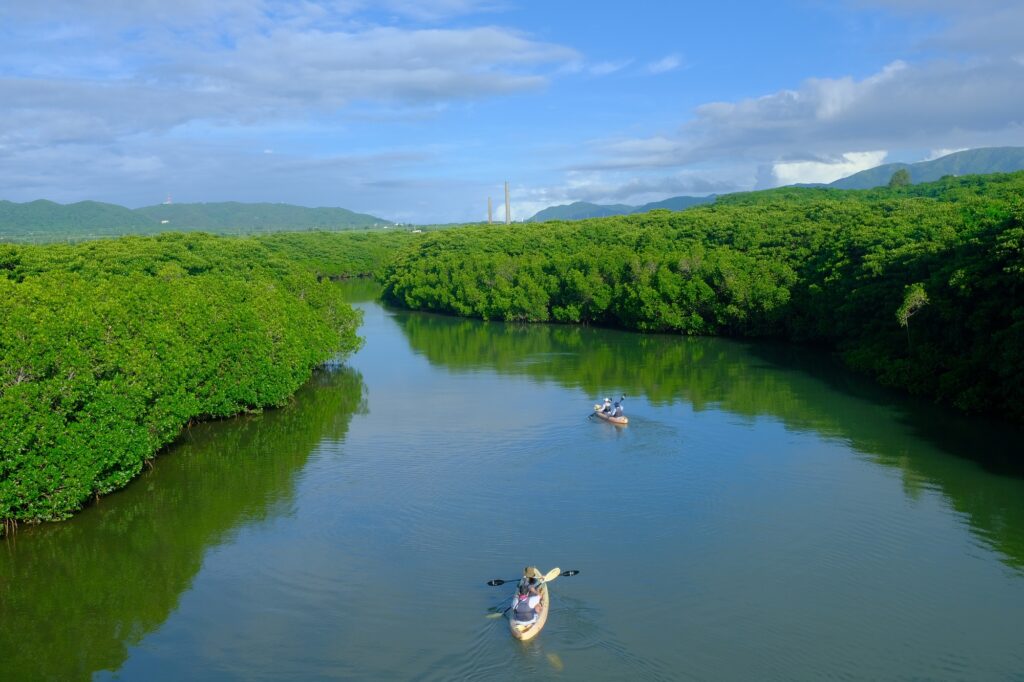
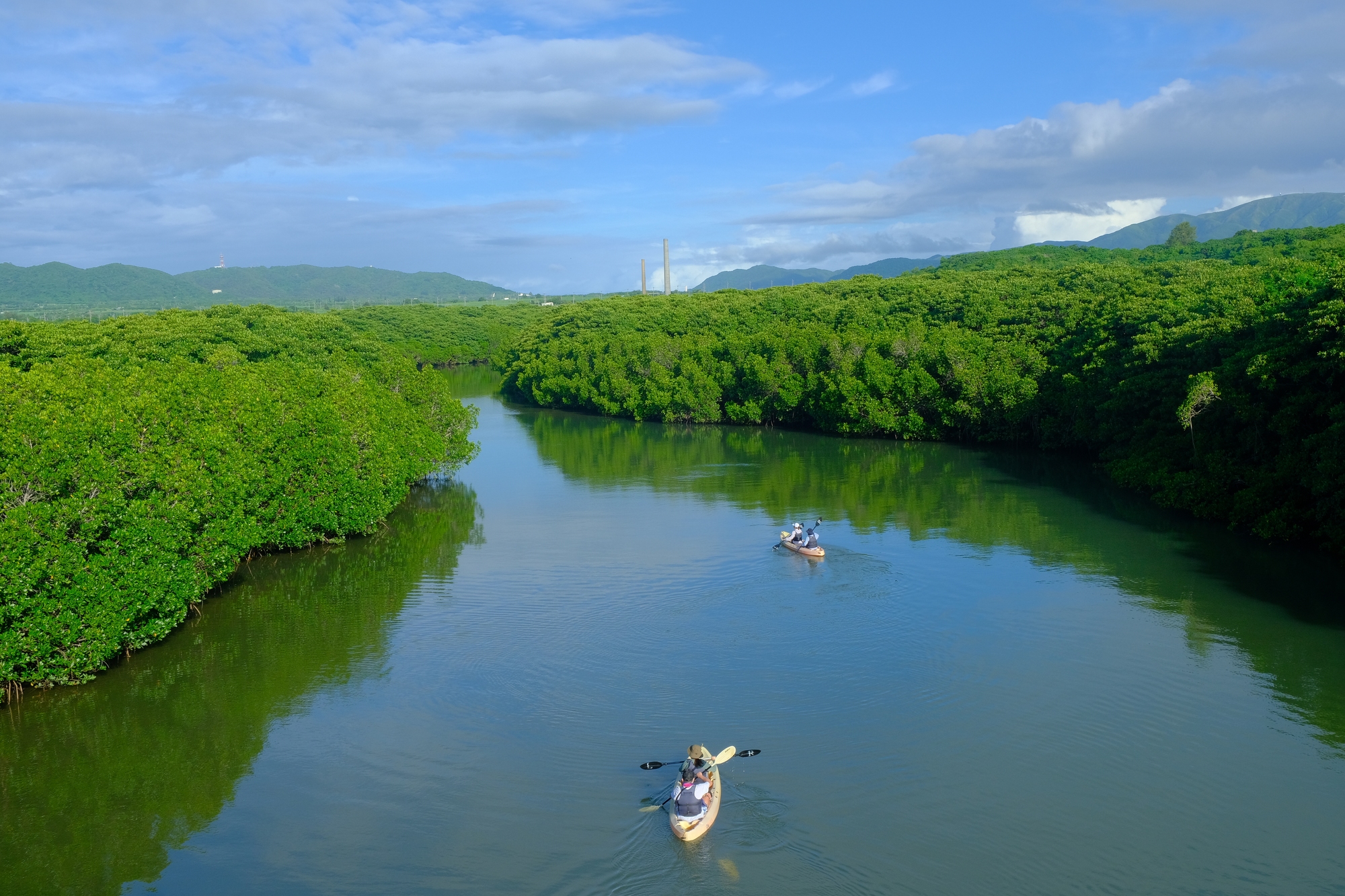
The Miyara River is a 12-km-long river with its water source at Mt. Omoto, Ishigaki’s highest peak. Ishigaki’s longest river, the island’s largest mangrove forest develops in its downstream region. It’s a major spot located on the opposite side of the island from Nagura Anparu near the river mouth, in the east-coast area.
Located right midway between New Ishigaki Airport and the Ishigaki Port Remote-Island Terminal, the good access of about 10 minutes by car from the airport and about 15–20 minutes from town is appealing too. It’s a spot loved from tourists to locals, with a location you can casually drop by even on Ishigaki’s arrival or departure day.
A national Natural Monument designated in 1972
The Hirugi forest of the Miyara River was designated a national Natural Monument on May 15, 1972 (Showa 47). The designated range is a mangrove grove of 225 ha in area developed along both banks 1,500 m from the mouth to upstream. As a Hirugi forest representing Okinawa, it’s a precious natural heritage known nationwide too.
| Designation info | Details |
|---|---|
| Designation date | May 15, 1972 (Showa 47) |
| Area | 225 ha (about 48 Tokyo Domes) |
| Range | Both banks 1,500 m from the mouth to upstream |
| Main species | Mehirugi, Ohirugi, Yaeyama-hirugi |
| Other vegetation | Hamanatsume, Kakatsugayu, gajumaru (banyan), etc. |
A precious environment where 3 kinds of Hirugi coexist
“Mangrove” isn’t the name of a plant, but a collective name for plants growing in the brackish-water zone where seawater and freshwater mix. In the Miyara River’s Hirugi forest, 3 kinds of trees of the Rhizophoraceae family coexist.
- Ohirugi (black mangrove): a tree with characteristic knee-like breathing roots
- Mehirugi (Kandelia): known as Japan’s northernmost mangrove too
- Yaeyama-hirugi (red mangrove): octopus-leg-like prop roots are impressive
In addition to these, diverse plants like Hamanatsume, Kakatsugayu, Himegama, Okinawa-sharinbai, Sarukakemikan and Adan can be observed too. Furthermore, large trees of the gajumaru (banyan), beloved as the “tree of good fortune,” can be seen too, and a landscape just like a southern jungle movie spreads out.
The Miyara River Mangrove’s Appeal | A Grand Adventure of Subtropical Jungle
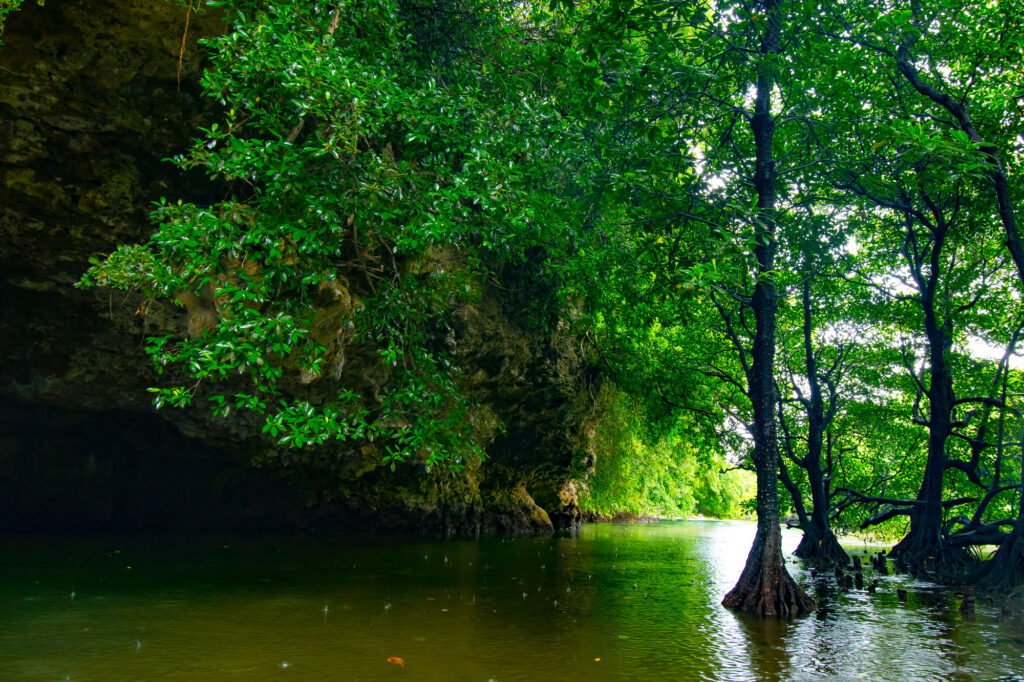
An extraordinary space where a dinosaur might appear
Step into the Miyara River’s mangrove forest and an extraordinary feel spreads out such that many visitors say in unison, “you forget you’re in Japan.” The octopus-leg-like prop roots of the Yaeyama-hirugi stand in a grove from the water surface, and overhead subtropical-specific vegetation grows thick and covers you—a worldview just like wandering into a dinosaur-movie set.
Dynamic and majestic nature that buzzes on SNS too as “scenery that might appear in a movie” or “like Jurassic Park.” It’s a spot we want travelers seeking a special experience far removed from everyday life to visit.
A paradise of life that changes its figure with the tide
A big feature of the Miyara River mangrove is that it changes its expression with the tide’s ebb and flow. At high tide the water level rises and a calm water surface like a lake spreads. On the other hand, at low tide the tidal flat appears, and mudskippers, gobies, and countless crabs show their faces, changing into a lively world.
Though the same place, you can have entirely different experiences by the time you visit—this is the mangrove environment’s greatest appeal. You can enjoy nature’s drama matched to the rhythm of the ebb and flow, which happens twice a day.
Abundant creature observation | crabs, mudskippers, bats
Since the Miyara River is a brackish-water zone where freshwater and seawater mix, it’s rich in nutrients and a treasure house of creatures. We introduce representative observation targets.
| Creature | Observation point |
|---|---|
| Mudskipper | A humorous figure leaping about on the tidal flat |
| Southern mudskipper | Runs around on the mud |
| Fiddler crab | A courtship dance waving its large claw |
| Sand-bubbler crab | The cuteness of eating sand to make balls |
| Mangrove marsh shrimp | An endemic species around the mangroves |
| Bat | Inhabits a small cave deep inside |
| Wild birds | Herons, sandpipers and many more |
| Clam/short-necked clam kin | Observable by clam-digging |
There are tours where you can drop by a small cave where bats dwell midway as you proceed by canoe. A small cave inside the mangroves, bats flapping within it—a movie-like experience awaits.
How to Enjoy the Miyara River | Adventure the River by SUP / Canoe
Standard activities | SUP / canoe (kayak)
The royal road of enjoying the Miyara River is cruising by SUP (stand-up paddle) or canoe (kayak). The experience of proceeding at your own pace on the water surface surrounded by mangrove forest is an overwhelming sense of presence you can’t taste from land.
| Activity | Features | Recommended for |
|---|---|---|
| Canoe (kayak) | Outstanding stability. Easy since you sit and paddle | Those with children, beginners, seniors, pregnant women |
| SUP | A standing posture, high eye level, with exhilaration | The active type, those aiming for photogenic shots |
| Sunset SUP/canoe | The fantastical air of dusk | Couples, the photogenic type |
| Night kayak | A mysterious darkness experience + starry sky | Those who want to taste the extraordinary |
A reassuring activity OK for beginners, those with children, and seniors
Since the Miyara River’s mangrove forest plays the role of a breakwater blocking rain and wind, the water surface is calm. An environment is in place where even those almost completely new to SUP and canoe can enjoy it with peace of mind. Many tours have family-supporting plans OK from age 0 too, and it’s popular with the senior generation as well.
For those who say “doing activities in the sea is a little scary” or “I’m worried about my child,” the Miyara River mangrove’s SUP/canoe is ideal. It’s time where you can meet a different appeal, different from the highly transparent sea.
Casual participation in a 2-hour time needed
Miyara River mangrove tours are mainstreamed by short plans of about 2 hours’ time needed. The fee is around ¥5,500–8,000, with many shops offering free photo data and equipment rental. With pickup, you can join casually even without a rental car.
The casualness of being easy to incorporate even in limited time, like an “arrival-day afternoon” or a “departure-day morning,” is appealing. Since it’s close to the airport, if you give your flight some leeway, it’s active as a last activity on the final day too.
A different appeal on sunset / night tours
Not only daytime, but the dusk-time sunset SUP/canoe and the nighttime night kayak are hugely popular too. The sunset seen across the mangroves is a painting-like beauty. At night, wrapped in silence and darkness, a full sky of stars and the mangrove silhouette create a fantastical world.
Observation of nocturnal creatures, the Milky Way covering overhead—a night tour where you can taste the extraordinary becomes an experience that levels up an Ishigaki trip.
Tours That Combine and Enjoy with the Miyara River Mangrove
Mangrove + Blue Cave | conquer sea and river
For those who want to savor Ishigaki’s nature over a full day, a set tour of mangrove SUP/canoe + Blue Cave snorkeling is recommended. A greedy plan that conquers both sea and river in one day, with a time needed of about 5 hours and a fee of about ¥13,500–20,000.
Mangrove + Phantom Island
A set tour of landing on Phantom Island (Hama Island) and the mangrove is popular too. A luxurious plan where you can enjoy two contrasting superb views—an emerald-green uninhabited island and a subtropical jungle—in one day.
Mangrove + tidal-flat stroll
On a tour combining canoe + tidal-flat walk, you can have the experience of touching creatures like crabs and mudskippers up close. Perfect for children’s nature observation, recommended for family memory-making.
Miyara River Mangrove Basic Information
| Item | Details |
|---|---|
| Location | Miyara, Ishigaki City, Okinawa |
| River total length | 12 km (Ishigaki’s longest) |
| Mangrove range | 1,500 m from the mouth to upstream |
| Mangrove area | 225 ha (48 Tokyo Domes) |
| Designation | National Natural Monument (1972) |
| Viewing | Viewable for free from Miyara Great Bridge |
| Activities | SUP, canoe, tidal-flat stroll (tour participation) |
| Tour fee | ¥5,500–8,000 (half day) |
| Time needed | From 2 hours (abundant short-time plans) |
Access to the Miyara River Mangrove
| Departure point | Time needed | Route |
|---|---|---|
| New Ishigaki Airport | About 10 min by car | National Route 390 toward town |
| Ishigaki Port Remote-Island Terminal | About 15–20 min by car | From town toward Shiraho |
| Shiraho Coast | About 5 min by car | A nearby spot |
| Town | About 15 min by local bus | Get off at “Miyara-bashi” bus stop, 2-min walk |
Accessible by either rental car or local bus
For the Miyara River mangrove, a rental car is convenient, but the feature is that it’s easy to access by local bus too. Get off at the “Miyara-bashi” bus stop from the town bus terminal, and it’s about a 2-minute walk to arrive. Since it’s right beside the road heading from the airport to town, you can visit casually even without a rental car.
Worth it just to gaze from Miyara Great Bridge
Even for those who say “I don’t have time to join an activity,” you can enjoy it plenty just by gazing at the mangrove forest from Miyara Great Bridge. From atop the bridge you can survey the full view of the mangrove forest, and especially the scenery changing its figure with the tide’s ebb and flow is overwhelming. It’s perfect as a short-break spot midway on a drive too.
At the foot of the bridge stairs are set up, and at low tide you can go down to the tidal flat and observe mudskippers and crabs. The casualness of being able to enjoy it for free is appealing too.
Cautions When Visiting the Miyara River Mangrove
Individual river descent is in principle NG | tour participation is essential
Since the Miyara River is designated a national Natural Monument, unauthorized individual SUP/canoe use isn’t recommended. Since rules for mangrove protection, knowledge of tides/currents, and safety equipment are needed, be sure to join a tour held by a local specialty shop.
Tour times vary with the tide’s ebb and flow
The Miyara River mangrove’s SUP/canoe tours vary in holding time matched to the tide’s ebb and flow. You can state a rough “morning” or “afternoon” preference, but the detailed time on the day depends on the high-tide/low-tide times. In summer (late June–end of September), due to fierce heat, many shops hold tours only in the early morning and evening.
Take thorough UV measures / squall measures
Even within the mangrove forest, sunlight pours down from overhead. Since Ishigaki is known for a high amount of UV through the year, take the following measures regardless of season.
- Sunscreen: a reef-safe type is recommended
- Hat: one with a chin strap that won’t blow off in the wind
- Sunglasses: with a strap to prevent loss
- Rash guard: sunburn + insect-bite measures
- Rainwear / change of clothes: in preparation for a sudden squall
Ishigaki sometimes has sudden heavy rain called a “squall.” It often stops in a short time, but there’s a chance of getting drenched too. Preparing large rainwear and spare change of clothes is reassuring.
For a tidal-flat stroll, sturdy shoes
When strolling the tidal flat, sturdy get-wet-OK shoes are essential. With beach sandals there’s a danger of cutting your feet on rocks or shells. Since many tours have marine-shoe or boot rental, using it is reassuring.
Collecting creatures/plants is strictly prohibited
Since it’s designated a national Natural Monument, collecting/taking home creatures or plants is absolutely NG. Keep to observation and shooting only.
Nearby Spots to Enjoy Together with the Miyara River
Shiraho Coast | a world-class-scale blue-coral grove
About 5 minutes by car from the Miyara River, Shiraho Coast is famous for a Northern-Hemisphere-largest-class blue-coral grove. A route savoring Ishigaki’s nature with mangrove + snorkeling is popular.
New Ishigaki Airport | the base of arrival/departure
New Ishigaki Airport, just 10 minutes by car from the Miyara River mangrove. As one of the sightseeing sites closest to the airport, it’s a location easy to use as an activity right after the plane arrives or before boarding.
Ohama Coast | a hidden spot for stargazing
Ohama Coast, about 10 minutes by car from the Miyara River. Close to town yet a quiet beach beloved by locals as a stargazing spot. It’s known for being able to see the Southern Cross too.
Furusto-bara Ruins | a history stroll
Deep inland of the Miyara River are the Furusto-bara Ruins. A historically important place said to be “the castle ruins of Oyake Akahachi.” Nature at the mangroves, history at Furusto-bara—you can also come to know Ishigaki deeply over a full day.
Recommended Model Courses for the Miyara River Mangrove
Arrival day | direct-from-the-airport course
- 13:00 Arrive at New Ishigaki Airport, arrange a rental car
- 13:30 Join the Miyara River mangrove canoe tour
- 14:00–16:00 Mangrove cruising
- 16:30 Head to the Ishigaki town hotel
- Evening Island-cuisine dinner in town
One-day course | mangrove + Blue Cave
- 09:00 Meet at the shop
- 09:30 Miyara River mangrove SUP/canoe
- 11:30 Lunch
- 13:00 Blue Cave snorkeling
- 15:00 Tour ends
Sunset course | a superb view from the evening
- 16:45 (winter) / 17:30 (summer) Meet in town
- 17:00 (winter) / 17:45 (summer) Arrive at the Miyara River
- 17:15–18:30 Sunset SUP/canoe
- 18:00–18:30 Sunset time
- 19:00 Hotel pickup
Miyara River Mangrove FAQ
Can I enjoy it with kids?
Yes, there are many shops OK to join from age 0, a hugely popular activity for families. With a stable canoe, small children are reassured too. The special-feeling experience inside the mangroves stays strongly in children’s memories too.
Is it OK even if I can’t swim?
Of course OK. Both SUP and canoe make wearing a life jacket mandatory, and even if you fall in the water, buoyancy keeps you safe. Since a guide always accompanies too, those not confident in swimming can especially enjoy it with peace of mind.
How long does it take?
The standard is a 2-hour plan. Including pickup time, about 2.5–3 hours. Since it fits compactly compared to Ishigaki’s other activities, it’s easy to incorporate into an itinerary.
What’s the going rate for the fee?
For a half-day (2-hour) plan, ¥5,500–8,000 is the going rate. Many shops have free pickup, photo data, and equipment rental, so the content is often more extensive than the fee suggests.
What’s the best season?
It can be enjoyed through the year. April–October is comfortable in both temperature and water temperature, a season when getting wet on a SUP feels good too. In winter too, many shops prepare wetsuits and rainwear, and most cases operate year-round.
Which is recommended, high tide or low tide?
For SUP/canoe cruising, high tide is recommended. The water level is high and you can proceed deep inland. Tours including a tidal-flat stroll are best at low tide. Since there are tours in time slots where you can enjoy both, choose to match your preference.
How do I choose a tour company?
The trick is choosing a shop that’s small-group, high in guide quality, with free photo data, equipment rental, and pickup. The cumulative participant track record, review ratings, and kid-friendliness are check points too.
Summary | A Grand Jungle Adventure, Ishigaki’s Largest, at the Miyara River Mangrove
The Miyara River mangrove is a Natural Monument Hirugi forest of 48 Tokyo Domes spreading along Ishigaki’s longest river. Three kinds of mangrove, the tidal flat of mudskippers and fiddler crabs, the small cave where bats dwell—a subtropical jungle such that “you forget you’re in Japan” spreads out.
The good location of about 10 minutes by car from New Ishigaki Airport, a casual tour of about 2 hours by SUP or canoe, and a reasonable fee of ¥5,500–8,000—the usability of being able to join casually even on an arrival or departure day is appealing. The safety enjoyable even by those with children, seniors, and beginners is a reason for popularity too.
Combinations with nearby spots like Shiraho Coast, the Blue Cave and New Ishigaki Airport are free too. With a one-day course conquering both sea and river, you can savor Ishigaki’s nature to the fullest. On your next Ishigaki trip, be sure to experience the grand adventure of subtropical jungle. Surely an emotion that doesn’t come across in photos awaits.
Book Your Rental Car Here


※For pick-ups or returns outside of business hours, please contact us by phone.
Access
Ishigaki Island Mirais Rent a Car Ishigaki Airport Branch
783-1 Shiraho, Ishigaki City, Okinawa 907-0242, Japan
*The address above shows a wide area. For the exact location, please click “View larger map” or “Open in Google Maps.”
Ishigaki Island Mirais Rent a Car Ishigaki Downtown Branch
704 Tonoshiro, Ishigaki City, Okinawa 907-0004, Japan
*The address above shows a wide area. For the exact location, please click “View larger map” or “Open in Google Maps.”
